Anthony KoutoufidesCategoriesAFL Players Elite Lifestyle Footy Tips

The Legendary Australian Rules Footballer, Anthony Koutoufides

Anthony Koutoufides rose to incredible prominence while playing for the Carlton Football Club. He is regarded by fans and pundits alike as one of the most potent and finest players of all time, owing to the versatility that allowed him to play every position. Koutoufides was in a class on his own, so much so that he was frequently called the prototype of the modern footballer.

Apart from his sporting greatness, Koutoufides has also made a name for himself, becoming an Australian celebrity and making several appearances on television shows. His most notable stints were in the Australian television series “Gladiators” where he played the character “Kouta,” and Australia’s version of “Dancing with the Stars,” which he won in 2006.

Playing Career

Koutoufides joined Carlton in 1990 after being recruited from Lalor. He played 50 games in the reserve squad, where he was named the best and fairest player in the league in 1991. In 1992, he began his AFL career with the Carlton FC. He rapidly proved himself to be one of the most dynamic and athletic players ever to play the sport. With a solid mark, a beautiful kick, and a hard-running style, the former state under-16 high jump champion, who excelled in the 110m hurdles and the discus, decided to transfer from track and field athletics to Australian rules football.

Throughout the early to mid-1990s, Koutoufides’ prominence rose, and by 1995, he had distinguished himself as a dominant player in the game. Highly regarded for his powerful mark and his extraordinary one-handed proficiency at stoppages, Koutoufides was more skilled than any other player in the league at plucking the ball up off the ground with one hand and then swinging that arm over opponents to set up clearing handpasses than any other player in the league. He was a member of Carlton’s 1995 premiership team and was named to the All-Australian team.

Koutoufides reached the pinnacle of his career in 2000, his most remarkable season. He appeared in 20 games, averaged 26 disposals, more than six marks, and almost two goals per game. In Round 8, he had a career-high 39 disposals against Sydney. He was the clear frontrunner for the Brownlow Medal before suffering a knee injury (torn posterior cruciate ligament) in front of 91,000 fans in Round 20 against Essendon. 

He was the clear frontrunner for the Brownlow Medal before suffering a knee injury (torn posterior cruciate ligament) in front of 91,000 fans in Round 20 against Essendon.  He’d also miss out on Carlton’s best and fairest, which Brett Ratten and Scott Camporeale. Still, he’d win the highly regarded AFLPA MVP Award (now known as the Leigh Matthews Trophy) and was named to the All-Australian team for the second time. His knee injury, though, would keep him out of the International Rules series.

Koutoufides’ recovered from his knee injury before the start of the 2001 season. He went on to earn his first club best and fairest award. However, he suffered another knee injury in the semi-final versus Richmond, this time a severe ruptured anterior cruciate ligament (ACL). He didn’t play again until Round 15 in 2002, and he only played three games that year, all while wearing a custom-made brace. For the next few years, Koutoufides’ jumping ability was significantly undermined. 

Koutoufides was named captain of the squad in 2004 after Andrew McKay retired, a role he retained until 2006. Koutoufides won his second best and fairest award as captain in 2005. He was once again a major component in Carlton’s midfield. 

Retirement From Illustrious Career

On July 31, 2007, Koutoufides announced his departure from AFL football. The choice was reached after a hip injury he sustained against St Kilda in Round 17 of 2007 was more severe than initially thought. Before the match against Collingwood in Round 18, 2007, he received a lap of honor and a standing ovation from the Carlton players and spectators. Koutoufides is Carlton’s all-time leading scorer with 278 games played. 

Koutoufides was a member of the century’s Italian and Greek teams, the latter of which he was nominated vice-captain. He is a Carlton Football Club life member. He is also a life member of the AFL, participating in 305 games (278 regular-season games, 26 pre-season games, and 1 State of Origin game). He was admitted to the Australian Football Hall of Fame in 2014.

Greatest Performances

Two particularly notable performances stand out in Koutoufides’ career. Koutoufides controlled the wing against West Coast in Round 5 of 1996 at Optus Oval. He had a career-high 18 marks, including the game-saving mark that kept the Blues in front by one point. For the Optus Oval farewell, it was entered into the “Memorable Moments” category. 

The second unforgettable performance of Koutoufides was his final quarter in the 1999 preliminary final against Essendon. Koutoufides went into the middle in the fourth quarter, drifting forward and back to finish with ten kicks and six marks, four clearances, three rebounds, and two goals, enabling the Blues to rally from an 11-point deficit to upset the heavily-favored Bombers by one point. Stephen Kernahan, a club icon (and later president), called the performance “the greatest quarter of football ever played.”

***

Be updated with the new trends. Listen to your favorite athletes and learn from reliable coaches. Subscribe to Prepare Like A Pro Youtube and Podcast!

Stefan MaukCategoriesElite Lifestyle Footy Tips

Stefan Mauk – The Attacking Midfielder

Stefan Mauk, the founder of Inner Game Journal, is an Australian professional soccer player. He stands out as an attacking midfielder and captain for the A-League club Adelaide United. His ability to play box-to-box midfield and right-winger positions demonstrate his versatility on the field.

 Having spent 18 months with Brisbane Roar, Mauk decided to return to Adelaide United in January 2020 for his second stint with the club. After joining the Reds in a brilliant midseason transfer four years earlier, Mauk was a crucial component in their historic Premier League and Championship doubles in 2016. Mauk is best known for his creativity and ability to break down defensive lines. After the 2015/16 season, he was signed by NEC Nijmegen, a Dutch soccer club.

Before the 2020/21 season, Mauk was made Captain of the Club, making him the team’s youngest skipper at 25. He has flourished under the increased responsibility, scoring seven goals in 25 appearances.

Excited for the New Season 

Stefan Mauk’s offseason has been anything but ordinary after getting married. The midfielder admitted he took some time to spend with his wife, which helped him recharge for the upcoming season. 

Because of the newly imposed COVID-19 restrictions, Mauk’s wedding date had to be postponed from its original date. The 25-year-old, on the other hand, is grateful that his wedding took place as planned a week later and in hindsight before the state’s seven-day lockdown began.

“It was really good,” Mauk said on Adelaide United’s official website. “It was a perfect day, and we had to push it back because of the first restrictions that came in. So we’re really grateful that we got to get it in before this new lockdown happened.”

The offseason saw a lot of changes for the club with three first-team regulars, namely, Ryan Strain (Maccabi Haifa), Jordan Elsey (Newcastle Jets) and Tomi Juric (Macarthur FC), leaving for new teams. Adelaide also re-signed Michael Jakobsen, Craig Goodwin, Javi López, and Juande and promoted Jonny Yull and Alexandar Popović to scholarship deals.

As disappointed as Mauk was in seeing his former teammates leave, he remains optimistic about the club’s fortunes in the upcoming season.

“It’s disappointing to lose players within the league,” he said. “You won’t be a club where people come to and want to stay and build their career on. But that’s part of football. It was great to see Ryan Strain get a move away, and that’s something the club is really big on – is helping South Australians reach their potential and giving them that platform to get overseas. It was awesome to see him do well.”

“And for the replacements, I know speaking to the coaching staff and with Vito (Basile) coming in, they’re working really hard to find some players. I’m sure the fans will be excited by the announcements to come.”

The club was just a game away from making it to the A-League Grand Final last season. During the break, Mauk spent some time looking back on the past campaign, saying, “I think our best was really good,” Mauk believed, who scored seven goals during 2020/21.

“And we showed against Sydney and against Melbourne City, who were the two best teams consistently, we can beat them when we’re playing our best. Our best was great, but I don’t think we were consistent enough, and that showed throughout the season. So it gives us a lot of positives going into this year. We’ve got a lot of young players which should all get better,” said Mauk.

Distinguished Young Career

The sixteen-year-old Mauk signed a two-year contract with Melbourne City in October 2012 after completing his studies at the Australian Institute of Sport. Mauk decided to return to Adelaide, his hometown, in January 2016 after signing with Adelaide United in a trade deal for Osama Malik, who had moved to Melbourne. 

On July 19, 2016, Mauk agreed to terms with NEC of the Dutch Eredivisie for a three-year contract. He made his competitive debut for the club in August 2016 against PEC Zwolle, but he was taken off the field at halftime in a 1–1 tie. In the aftermath, Mauk’s status at NEC regressed, giving rise to reports that he would be loaned out to another team in January 2017. 

In the end, no deal was struck, and Mauk remained at the club until May 2017, when manager Peter Hyballa was fired. He had yet to add to his early-season tally at the time. With three appearances in all contests as NEC were relegated to the Eerste Divisie, Mauk announced his intention to seek employment with another club. He stated that he desired more regular playing time and a more challenging league environment. 

With his former club, Melbourne City, as his 2017–18 season destination, Mauk has returned to Australia on a season-long loan deal. Mauk signed a four-year contract with Brisbane Roar on May 28, 2018, following his release from NEC.

Be updated with the new trends. Listen to your favorite athletes and learn from reliable coaches. Subscribe to Prepare Like A Pro Youtube and Podcast!

Belle DawesCategoriesAFL Players Elite Lifestyle Footy Tips Podcast

Belle Dawes – The Energetic Lion Who’s Doing it All!

Even though she is only 21 years old, Belle Dawes has made an immediate impact on the AFLW competition. She has already been named to the AFLW Premiership team in 2021, has been nominated for the NAB AFLW Rising Star award in 2021, and has been named to the AFLPA 22 Under 22 Squad in 2021, despite only being in her third season. Known for her unbridled passion for the game and her team, the Lions Academy product will be hoping to build on her previous success with another successful campaign.

Belle Dawes is a true gem. With her self-assuredness, her rule of thumb, and unmatched footy talent, many people have helped make all she has possible. It’s easy to see why everyone loves helping this young woman achieve what she wants in life because it means influencing someone you know will do the same for others when they get the chance! Whether that’s Belle’s mother always believing in her or just being accepted into an all-boys football club – mixed with everything else included – allowed Belle to realize one day playing AFLW was something worth fighting for!

Humble Beginnings

When Dawes first started playing football, the young Victorian didn’t play with girls. There were no girls to play with at all – and if you asked her when she was twelve years old if she could imagine playing in Australia’s highest women’s competition of AFL footy, it would have been a ridiculous question for her to consider because there wasn’t even any such thing as “women’s footy” yet!

Despite the adversity, Dawes became one of the most promising draft hopefuls to be picked in AFLW. Playing with boys taught her that confidence is critical; this Brisbane Lions Academy product knew she could make it happen when given a chance.

“When I first started playing, it was like ‘oh it’s a girl,’ and then a lot of the better players in that team started liking me, then I was seen on the same level as them,” Dawes shared in an interview with aflq.com.au.

“Getting respect from that [meant] when I would go into a game [thinking] everyone actually knows I’m alright. I remember one last game, it was 2012 and one of the boys tackled me and the whole crowd cheered, because they got me.”

Working with Starcevich Early On

Dawes well knows the fact that it takes many factors to create a masterpiece, and present Brisbane Lions head coach Craig Starcevich has played a role in this one is no secret either.

“When Craig first saw me, he really loved my game, he called me Dawsey straight away,” Dawes relayed. “The club is Craig, he’s not one of those coaches who is just going to yell at you, he genuinely wants the best.”

Dawes recalls a game in which her team didn’t perform up to expectations. Still, instead of being punished by an enraged coach, Starcevich jumped at the chance to observe how they were performing under a lot of stress.

“He makes us think about our game and keeps pushing us for more, even the way you’re thinking about it or holding yourself on the field,” Dawes said. “People always ask what your dream is and I thought I couldn’t say AFL but mum was like ‘yes you can, you can do anything, if you want to play AFL do it’,” she added.

Dawes’ ability to perform, which she possesses in spades, was the most critical factor in her success. Dawes was selected as the only female participant out of 400 applicants to participate in the DraftStar Tim Watson Scholarship program when she was 12 years old. She received a year of individualized football development as a result of her selection.

That was nearly a decade ago, and she has come on leaps and bounds in the time since then. Dawes had the highest number of games played in the middle of the 2019 competitions, with more than 12 games played. In addition, she was one of six Queenslanders welcomed to the NAB AFLW Draft Combine in Melbourne, where she performed admirably in the agility portion of the test.

On the other hand, speaking with her would not provide you with an accurate inkling of just how much natural ability she possesses.

“I felt average; I didn’t feel like I was less or better, just right where I wanted to be. I was confident.”

Onto the AFLW

In 2019, Brisbane drafted her 15th overall pick in the AFL Women’s draft. She had been playing for Maroochydore in the AFL Queensland Women’s League at her selection. She then made her Lions debut on February 8, 2020, in the team’s round one match against the Adelaide Crows at Hickey Park. She has since extended her contract with Brisbane for one more year, which will begin on June 15, 2021.

AFL Athletic Development 1000x565 1CategoriesRecovery

AFL Athletic Development

A popular method to transform yourself into a better football player is to improve your athletic ability, not simply by playing more football games. AFL strength & conditioning programs will help you run faster for longer, change directions faster, and bring your game to the next level.

Resistance training can help you achieve your goals, whether you’re a professional AFL player wanting to better your opportunities in the AFL system, a NAB league player training for the AFL combine, or a local league player wanting to prepare for the next level. strength & conditioning programs designed by AFL coach backed by research and an outstanding curriculum, assist football players to improve their speed, strength, and explosiveness. 

AFL strength & conditioning programs are specially geared to help you gain these benefits and more:  

1) Improve your speed, stamina, and repeat speed.

On the field, what’s the difference between excellent and great? Speed. Whether or not you make the cut is determined by appropriate movement methods, which can shave 0.2 seconds or even more off your 5-10-20 meter times. However, speed means little if you’re not operating efficiently. To increase synergy and speed, athletic training combines appropriate sprinting techniques with football drills like small-sided games.

The key to success in the AFL is not only being fast but also being able to reproduce those bursts of acceleration throughout the game, particularly late in the fourth quarter when it matters most. Having a unique grasp of how to improve a player’s “engine” and fill it with “horse power,” will set you apart from those who believe all it needs is a brisk jog around the pitch.

2) Improve your vertical leap and strength

What is the secret to attaining success in the AFL? In the fourth quarter, the elite dominate in terms of marking and tackling. Coaches who specialize in strength training develop programs that improve core strength, stability, and power output. This will provide you the upper hand in the game, allowing you to finish stronger and be more resilient than your rivals.

3) Have more balance and agility 

Incredible plays necessitate more than simply physical prowess. Our Coaches will improve your mobility with conditioning training regimens that improve foot quickness and lateral movement. Weight distribution, balance, agility, and lateral cutting prowess all improve as a result.

4) Lessen the chances of an injury

You can’t play the game if you’re on the sidelines or recovering from a reoccurring injury. With strength training, injury prevention exercises, and movement analysis, you’ll be able to help increase your likelihood to stay in the game and play it the way you want. Our AFL strength and conditioning programs can help you reduce your chance of injury. A specialized program that helps reduce the frequency of acute and overuse injuries is the main of a strength and conditioning program. 

AFL Physical preparation 

For football clubs and their players’ health, comprehensive strength and conditioning program is critical.

Is your team fit enough to outrun a faltering foe in the final quarter of a game? Because of their core strength, are your athletes able to hold their own in battles and blast through tackles? Do others comment on how fortunate your team has been in escaping serious injuries?

Strength and conditioning programs are implemented into junior football and are an important part of preparing your physique for competitive football. Sample strength and conditioning regimens used by the AIS/AFL academy are offered below for teams to apply at their respective clubs all through the four parts of the season:

  • Off season (8 weeks)
  • First half of pre-season (8 weeks)
  • Second half of pre-season (12 weeks)
  • In-season

These programs are designed for athletes between the ages of 16 and 18. The administration of these programs should preferably be overseen by a strength and conditioning professional. This program’s elements may be applicable to senior football. This program, however, should not be applied to players under the age of 16.

Off-season (8 weeks)

Five programs coaches can implement throughout the off-season:

General Strength 1

  • Push up 
  • Dumbbell single-arm rows 
  • Plate overhead step-up
  • Alternating shoulder press
  • Lateral squat to figure 4 position 

General Strength 2

  • Dumbbell bench press 
  • Single leg banded Adduction 
  • Stability ball single leg squat
  • Dumbbell push press 
  • Reverse grip pull up

Balance

  • Single leg calf raise 
  • Single leg banded hip hitch 
  • Stability board half squat

Core Strength

  • Plank 
  • Hollow hold 
  • Side plank 
  • Bridge 

Stretching

  • Calf stretch
  • Soleus stretch
  • Frog stretch 
  • Quadriceps stretch

The first half of pre-season (8 weeks)

Five programs coaches can implement throughout the first half of the pre-season:

General Strength 1

  • Dumbbell Bench press
  • Bodyweight inverted rows 
  • Dumbbell hang power clean
  • Reverse lunge 
  • Single leg rdl 

General Strength 2

  • Barbell hip thrusts 
  • Dumbbell bicep curl press and press 
  • Hammer grip pull-ups 
  • Box squat 
  • Bench press

Balance

  • Single leg squat
  • Single leg Balance (eyes closed) 
  • Stability board half squat
  • Jumps balance 
  • Lateral bound balance

Core Strength

  • Plank 
  • Hollow hold 
  • Banded Pallof press 
  • Banded wood chop 
  • Side plank with leg abduction 

Stretching

  • Lower back stretch 
  • Soleus stretch
  • Hamstrings sit & reach 
  • Quadriceps stretch
  • Couch stretch

The second half of pre-season (12 weeks)

Five programs coaches can implement throughout the second half of the pre-season in the lead-up the start of the season:

General Strength 1

  • Box jumps
  • Push up claps 
  • Single leg depth jumps stabilization 
  • Bench press 
  • Wide grip lat pulldown

General Strength 2

  • Bench pull  
  • Smith machine figure 4 switches 
  • Smith rack pull up horizontal 
  • Single leg swissball hammy curl 
  • Dips

Trunk strength 

  • Hollow rock 
  • Dumbbell pull over 
  • Side-lying hip abduction 
  • Stability ball rollout 
  • Stability ball rotation 

Stretching

  • Quadriceps stretch 
  • Hip flexor quadriceps stretch 
  • Hip flexor stretch 
  • Iliotibial band torso side bend stretch

In-season

Six programs coaches can implement throughout the competition phase of the season:

Early-week moderate intensity

  • Half squat 
  • Incline chest press 
  • Reverse grip pull up 
  • Single leg bridge 

Mid-week strength

  • Deep squat 
  • Bench press 
  • Trap bar Deadlift 
  • Narrow grip lat pulldown

Core strength

  • Stability ball circuit 
  • Side prone side stabilization 
  • Side-lying stabilization hip abduction

Stretching

  • Shoulder stretch 
  • Calf stretch 
  • Soleus stretch 
  • Neck stretch 
  • Groin stretch

End of week strength

  • Med ball throw 
  • Single leg squat 
  • Bench press
  • Weighted pull up

Follow Prepare Like A Pro Facebook Page and Prepare Like A Pro YouTube Channel to get regular updates from Melbourne strength and conditioning experts.

David MirraCategoriesElite Lifestyle Footy Tips

David Mirra – The 3Ps Footballer

In more than ten years, football is life for the 30-year-old David Mirra. As the 2021 Australian Football League (AFL) marks the 2nd season during a pandemic, the Sports World brings back to life the struggles and successes of a young footballer who never backs down in reaching his lifelong goals. His career in defending his local Victorian Football League (VFL) has been with flying colours. And his ascend from VFL to AFL was one worthy of emulation.

The bearer of #32 in Hawthorn Football Club, this 2018 rookie draft has his hands full. His story of sports success is heading its way towards feature pages. This is something he truly deserved. Adjudged as the best in the VFL field during the 2018 grand finals, he stands up to the audience’s expectations. 

Patient.

He was working on his dreams since day one. The Big Goal is to play the AFL. He never missed every draft opportunity. His patience can be traced as far back when he was 18 years old. He has the patience – the right attitude for every athlete who looks at the big picture. And just as he wanted, he reached his goal. The years of hard work polished him to become the most celebrated team captain and defender of his local league.

Persistent.

Twice the VFL Premiership player (2013, 2018), twice The Box Hill best and fairest (2016, 2019), three times VFL team representative, four times VFL Team of the year, a VFL Premiership Captain, and a recipient of Norm Goss Memorial Medal – Mirra’s football career grew pretty well over the years. His playing career highlights his persistence in getting his team ahead of the game, and he succeeded in doing just all of that. The Hawthorn Football Club saw that potential, and that’s where he moves right in.

Perseverant.

Giving up was not an option for the VAFA club Collegians 2020 football legend. His game statistics showcase his flexibility and dependability in every game he played. He persevered in going up top. He is a solid representative of how an aspiring and determined local player can make it towards the big games, accepting every challenge thrown at him, learning from every season, and using it all for his growth and professional growth advantage.

By the end of the 2019 season, Mirra has played a total of 155 games in favor of his home league, Box Hill Hawks. He was captain of the team, spearheading 78 matches, which is then a club record. His lifelong ambition of playing in the big yard took a bend when he was chosen as a rookie draft by the AFL Hawthorn. This happened only weeks before the infamous captain decided to return to the local football courts. It is all about timing and maintaining the right attitude. David Mirra is a footballer with 3Ps – patience, persistence, and perseverance.

Be updated with the new trends. Listen to your favorite athletes and learn from reliable coaches. Subscribe to Prepare Like A Pro Youtube and Podcast!

Prepare like a pro blog Heart rate variability HRVCategoriesRecovery

Heart Rate Variability (HRV)

What is HRV?

HRV is the time difference between each R–R interval; that is, the time difference from heartbeat to heartbeat. HRV tracking shows that the time between each heartbeat is not the same each time; it varies with every beat. Hence, the term heart rate ‘variability’.

rr-intervalHRV has been shown to be a predictor of illness in elite athletes. However, its ability to predict injury is yet to be validated in humans. It wasn’t so long ago that HRV tracking was only possible using expensive medical equipment, such as an electrocardiogram. Now, HRV can be reliably measured using health-tracking technology such as smartphone applications, heart rate monitors and finger-wave pulse sensors. This technology can accurately measure HRV during ultra-short durations (1 minute) in either a supine, seated or standing position.

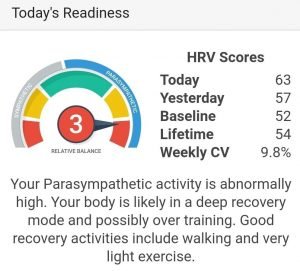
Todays readinessWhile many metrics are used to measure HRV, the most common and (and arguably most reliable) is  the root-mean-square difference of successive normal R–R intervals (RMSSD). The RMSSD measure is the most valid and most-researched measure and is therefore practical to apply to sporting settings.

How HRV is used to determine recovery status

It is important to remember that HRV provides critical information about the function of the ANS and that it is also the most reliable measurement of ANS function. An increase in HRV represents a positive adaptation/better recovery status, while a reduction in HRV reflects stress and worse recovery status. Having said that, it is also important to note that higher is not always better, and lower is not always worse (this will be discussed below). But as a golden rule of thumb, the higher the athletes HRV, the fitter/better recovered they are, and vice versa.

The ANS comprises two branches: the sympathetic nervous system (SNS) and the parasympathetic nervous system (PSNS). The easiest way to distinguish the differences between these two branches is to associate fight or flight responses with the SNS and rest and digest responses with the PSNS. Therefore, the SNS increases heart rate and the PSNS slows it down.

How HRV is used to determine improved wellbeing

Numerous studies provide evidence that coherence training consisting of intentional activation of positive emotions, paired with HRV coherence feedback, facilitates significant improvements in wellness.

How HRV used to determine

5 tips for tracking HRV

1. Ensure consistency between readings

For more accurate and relevant comparisons, consistent and repeatable measurements should be performed as much as possible. This will minimise confounding factors or misleading results. When using HRV trends to make important health and performance decisions and assessment, athletes must ensure they are comparing ‘apples to apples’ and not ‘apples to oranges’. Factors that affect repeatability and comparability include:

  • Time of day – Athletes should attempt to target the same 1-hour window each day, as circadian rhythm has a significant effect on HRV.
  • Body position – Athletes should ensure they use the same measuring position (i.e., sitting, standing or laying) every time, as torso angle has been proven to affect HRV.
  • Activity before HRV reading – Exercising, conversing, eating and caffeine intake are common factors that affect HRV. For optimum comparability between readings, athletes should perform the same activities between readings (e.g., always take baseline readings soon after waking up).

2. Strive for a low reading in the right setting

Chronically low HRV is, as a general rule, not what athletes should be striving for. However, a single or handful of low HRV readings is not always bad. In fact, strategic acute drops in HRV can be favourable, as long as HRV recovers to normal or better levels. Listed below are situations in which a low acute HRV is desirable.

  • A slightly lower HRV compared to the athlete’s baseline (associated with increased sympathetic nervous system activity) on a competition day can be favourable, depending on the activity.
  • An acute HRV drops after an intense workout or series of workouts that returns back to normal or better within a few days or weeks’ time can indicate good health.
  • A sudden drop in HRV after a change in nutrition, training method or lifestyle can indicate that the change is working.

3. Do not always assume a high reading is good

Just as a low HRV reading is not always bad, a high HRV reading is not always good. If a single HRV measurement is abnormally high compared to the athlete’s baseline or norm, then it can mean that something is off. Listed below are examples of when a high reading does not indicate better health.

  • When in a state of hyper recovery. This indicates that the body has accumulated too much stress, to the point that it can no longer effectively handle the stress and the body’s resources become depleted. In this situation, the body might force itself into a hyper-recovery mode  to protect itself. This state is not ideal for long-term health or performance.
  • When under continuous low-grade stress. These constant stressors can cause HRV to be higher in the short term because the body is constantly trying to recover. If an athlete’s HRV is high but they frequently feel fatigued or drained, then they might be exposed to chronic low-grade stress that is constantly consuming energy and resources.

4. Extrapolate multiple HRV readings

The body is in a constant state of flux as it responds to stressors and undergoes recovery processes. As such, one short HRV measurement might be skewed and not capture the body’s ‘normal’ state. One measurement could only capture a good day or a bad day and may not reflect the athlete’s norm. For example, a person’s HRV the day after staying up all night drinking alcohol will be very different to their HRV on a night that they go to bed early and don’t drink any alcohol.

When trying to understand HRV, it is important to take several days’ worth of measurements within a week (ideally over several weeks). This ensures that the single day is not an outlier. This also increases confidence in the baseline values that can then be used to more effectively set health and performance goals and to assess progress.

5. Use a heart rate monitor, not a wrist-based PPG monitor

An inaccurate measurement means an inaccurate (and invalid) HRV value. Accuracy is critical when when using HRV as a tool for training or health. Heart rate monitors like the Fitbit Charge or other wrist-based PPG or pulse-oximetry monitors are not compatible with measuring HRV. This is because many of these devices were not designed with the intention of measuring the more detailed heart rate fluctuations needed to calculate true HRV. They either do not record the R-R intervals or they provide smoothed, averaged or altered R-R intervals that remove the variability that comprises HRV.

Although these devices are suitable for measuring basic heart rate, there is no such thing as a ‘quick and dirty’, ‘good enough’ or ‘almost accurate’ HRV measurement. HRV values are a measure of normally imperceptible changes in heartbeat activity that often correlate with activity of the autonomic nervous system (ANS). A quick and dirty measurement from an inaccurate device yields a completely useless HRV value that should not be used for decision making.

There are many new HR devices with bold promises and the lure of convenience. Although wearable technology is progressing quickly, athletes should still be wary of these devices. Due diligence is important for understanding if the device is compatible with HRV calculations.

Prepare like a pro blog learning while sleeping neuroscience shutterstCategoriesElite Lifestyle

HOW BETTER SLEEP CAN IMPROVE ATHLETIC PERFORMANCE

If there was a supplement that you could take that provided the same benefits as a quality night of sleep, it would sell out all over the world … and potentially be a banned substance. To feel refreshed and energetic upon waking up, most adults require approximately 8 hours of sleep. To allow their bodies to recover from training sessions, athletes need between 9 and 12 hours of sleep. While more sleep improves health, sleep deprivation can have a range of debilitating consequences. It restricts cognitive function, can cause mood fluctuations, increases daytime tiredness, and impairs learning and memory. However, as much as science (and our body!) tries to remind us how important sleep is, most people aren’t practicing the basics, as well as they, should be.

Benefits of sleep

Performance enhancement

Sleep helps your brain to work properly, improves memory, assists with concentration, regulates hormones such as testosterone, and helps to repair and grow soft and connective tissues. The best type of broad-spectrum supplement that an athlete can take is a full 8 hours of sleep every night!

Faster reaction times

During a game, every millisecond counts. Inadequate sleep can greatly impair reaction time; 22 hours without sleep can impair an athlete’s reaction time as much as if they had consumed four alcoholic drinks. Poor sleep impairs judgment, while good sleep fuels the body’s ability to concentrate, remember and learn. When energy is running low, the brain has much more difficulty organizing and retaining new information. The best way that an athlete can prep for game day is by sleeping well in the nights leading up to the game.

Injury prevention

In AFL football, players have to use their instinctive reactions to protect themselves from potentially injurious collisions. Tired athletes are slower to react, increasing the likelihood of injury. Additionally, insufficient sleep doesn’t allow the body time to repair from the stress of workouts and games. Further, because exhaustion also affects the immune system, sleep-deprived athletes are more susceptible to illness and overload-type injuries.

7 tips for better sleep

1. Aim for more hours of sleep before midnight

Think about it from a weekly point of view and aim to maximize your total sleep between 9 pm and 12 am. A weekly goal of between 10 and 1 5 hours is ideal.

2. Avoid afternoon caffeine

Caffeine has a 6-hour half-life, during which time it continues to stimulate the nervous system and can prevent the drinker from feeling at ease. As such, caffeinated drinks consumed in the afternoon can negatively affect sleep quality. For a better night’s sleep, avoid caffeine after 2 pm.

3. Switch off electronic devices

Devices such as smartphones and laptops radiate blue light, which confuses the brain, as it takes this as a sign that it’s still daytime and stops producing hormones such as melatonin that promote relaxation and deep sleep. Try to avoid watching TV or using laptops and mobile phones an hour before sleeping and turn to calm, relaxing activities instead, such as reading or coloring in.

4. Sleep in a dark room

Set up your bedroom so that it resembles a dark cave. This assists with your circadian rhythm, a natural internal process that helps to regulate melatonin production, and the sleep-wake cycle, which repeats approximately every 24 hours.

5. Create a sleep routine and stick to it

Establish a sleep and wake time and stick to it, even on weekends and especially in the lead-up to competition or game days. Irregular sleeping patterns affect your circadian rhythm and melatonin production.

6. Relax before bed

It can be very common for athletes to experience stress and anxiety in the lead-up to a competition or game day, especially the night before. This increases cortisol levels and negatively affects melatonin production. Physical and mental recovery techniques, such as massage, stretching, bathing, and meditation, can reduce stress and result in a good night of sleep.

7. Never stay up late for something that wouldn’t be worth getting up early for!

heart rate variabilityCategoriesRecovery

HEART RATE VARIABILITY

heart rate variabilityHeart rate variability what is it?

Research suggests its the best non-invasive objective measure for monitoring recovery and general wellbeing.

How does it work?

First thing in the morning you place your fingertip in the core sense device for 2 minutes while it analyses your pulse.

After the reading, you get an instant report from the free Elite HRV app giving you feedback on whether you’re in a parasympathetic dominant state ie (relaxed) sympathetic dominant state ie (stressed) or your nervous system is in balance.

From a physical preparation point of view, this takes the guesswork out of load management and allows for a more individualized approach when adjusting the athlete’s training program.

I’ve used Elite HRV personally for the last 5 years and It’s helped increase my awareness around physical and mental/emotional stress and how to influence my nervous system for the desired state.

More recently I have completed the Elite HRV foundation course and I’m applying the methods with the athletes I work with at Prepare Like A Pro.

I love it for the objective data it provides not only to guide training but also to monitor how the athletes are coping during the pandemic.

For more questions feel free to give me DM

CategoriesRecovery

Best Cardio Exercise

Lorem ipsum dolor sit amet, consectetur adipisicing elit, sed do eiusmod tempor incididunt ut labore et dolore magna aliqua. Ut enim ad minim veniam, quis nostrud exercitation ullamco laboris nisi ut aliquip ex ea commodo consequat. Duis aute irure dolor in reprehenderit in voluptate velit esse cillum dolore eu fugiat nulla pariatur.