Stronger Injury Free HamstringsCategoriesFooty Tips Podcast

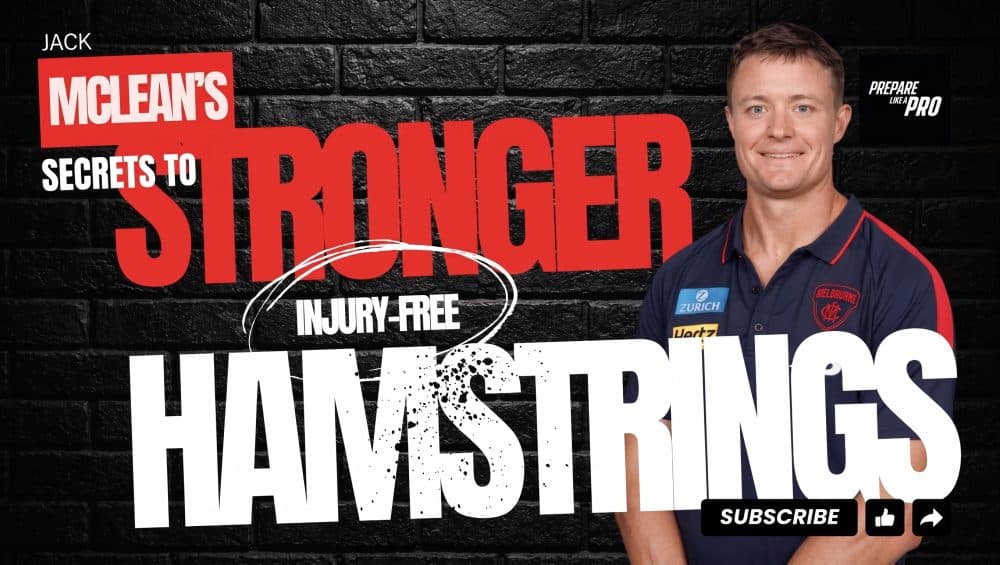
#177 – Jack McLean’s Secrets to Stronger, Injury-Free Hamstrings

Why do hamstring strains keep sidelining athletes, even in well-run programs? In this episode, we break down the risk factors you can actually control and the ones you can’t, with a focus on building Stronger Injury Free Hamstrings through smarter, more complete training. We’ll explore why the knee shouldn’t get all the attention in your strength work, how chaotic contest moments expose gaps that training often misses, and what it really takes to develop Stronger Injury Free Hamstrings. We also unpack why max velocity sprinting is only part of the picture, the simple test that reveals a quality hip hinge, and the strength benchmarks worth chasing on the Nordic and RDL.

Stronger Injury Free Hamstrings

Eccentric strength builds resilience

First, keep eccentric hamstring work in the program all year. Nordics, RDLs, and lengthened hamstring exercises teach athletes to absorb force while the muscle is under tension. This matters for sprinting, jumping, and high-speed actions. Rather than treating hamstring work as preseason, build it consistently and progress the load.

Let the hamstrings work naturally

Next, remember that athletes do much more than bend the knee. They hinge at the hips, rotate, lean forward, and react when contact changes their position. Therefore, include hip dominant and rotational exercises. These patterns help athletes stay comfortable when forced into unfamiliar positions during competition.

Prepare for real speed

Also, do not make maximum velocity the only speed target. Start with short accelerations, then progress toward longer sprints, curved running, reactive drills, and resisted efforts. By building exposure gradually, you give the hamstrings time to adapt to speeds without chasing all out efforts.

Strength needs control

Furthermore, numbers alone do not tell the story. Watch how an athlete moves. Can they hinge without losing spinal position? Can they control their pelvis? Can they stay balanced on one leg? A single leg lateral landmine can reveal whether strength is supported by movement control.

Make strength useful

Finally, strength matters most when athletes can use it under pressure. Benchmarks can guide training, but they should never replace good technique. Athletes should be able to absorb force, control body, and produce force confidently when sprinting, changing direction, or competing.

Highlights of the episode:

– The hamstring risk factors you can actually control
– The importance of resilience beyond just loading the knee
– Why different types of exposure matter beyond sprinting
– The movement competency marker most coaches can’t measure
– How much strength is enough for injury-free hamstrings?

🎥 Watch full episode on YouTube
🔗 https://www.youtube.com/@preparelikeapro
📅 Book a FREE discovery calls for coaches
👉 https://calendly.com/plp2

Listen Now & Subscribe!

🎧 Available on Spotify, Apple Podcasts, and YouTube
📲 Follow us on Instagram: @preparelikeapro
💡 Learn more at preparelikeapro.com

Listen: iTunes | Spotify

Book a FREE Coaching Discovery Call: https://scheduler.zoom.us/jack-mclean-wm92x1/15-min-discovery-call

Are you ready to enhance your coaching? Uncover the strategies to build a thriving online platform, liberating yourself from the time-for-money constraints while pursuing a career as an AFL S&C coach.

Book a FREE coaches discovery call
https://calendly.com/plp2/15min
Field Sport Movement MechanicsCategoriesFooty Tips Podcast

#175 – Common Mistakes in Movement Mechanics for Field Sports (And How to Fix Them)

Could hidden movement mistakes be limiting your speed, agility and durability? We break down the mechanics field-sport athletes often get wrong, from upright running and overstriding to acceleration, cutting and defensive movement.

We also explore practical assessment methods, useful off-season training environments and the drills that can create genuine transfer to competition. Whether you coach AFL players or train for another field sport, this episode will help you view athletic movement through a sharper lens.

Field Sport Movement Mechanics

Build Better Movement Foundations

Strong field sport performance starts with efficient movement mechanics. Athletes must sprint, accelerate, cut, and defend without wasting energy or placing unnecessary stress on their bodies. However, small technical errors can quickly reduce speed and increase injury risk. By understanding field sport movement mechanics, coaches and athletes can build safer, sharper, and more confident movement patterns during training and competition.

Stop Overstriding at Speed

First, avoid overstriding during upright running. When the foot lands too far ahead of the center of mass, the body experiences a braking effect that slows momentum. This position may also place greater stress on the hamstrings. Instead, athletes should aim to land closer beneath the body, creating smoother ground contact, better rhythm, and more efficient forward movement at speed.

Align Your Acceleration Angles

Next, pay attention to acceleration posture. During the first three steps, the shin and torso should generally point at similar angles. This alignment helps athletes project their bodies forward rather than rising too early. A simple side-view video can reveal whether the posture is effective. Coaches can then provide practical cues and drills based on what they observe in training.

Cut and Defend Efficiently

Moreover, field sports demand efficient movement in every direction. Attackers need to step and cut with minimal footwork so they can create space quickly. Meanwhile, defenders must stay low, balanced, and loaded to react or tackle. Timing gates are useful for measuring acceleration, while GPS can support sprint monitoring, although its acceleration data may be less dependable in some situations.

Train, Retest, and Adapt

Finally, the off-season is the ideal time to address movement weaknesses. Bounding, trampoline work, gymnastics, and multidirectional plyometrics can improve reactive strength and body control. Nevertheless, progress requires patience and consistent exposure. Athletes should follow a structured program for at least six weeks before retesting, although eight to ten weeks usually provides enough time for meaningful adaptation and measurable results.

Highlights of the episode:

– Is overstriding putting your hamstrings at risk
– What shin and torso alignment reveals
– Why efficient direction changes demand less footwork
– Are your movement tests giving reliable answers
– The off-season tools most athletes overlook
– How long should a movement training block last

FAQ

Q1. What are the most common movement-mechanics mistakes in field sports?
Common mistakes include overstriding while running, standing upright too early during acceleration, and taking unnecessary steps when changing direction. These errors can reduce speed, waste energy, and increase stress on the muscles and joints.

Q2. How can athletes improve their acceleration and running mechanics?
Athletes should land with their feet closer beneath their body to reduce braking forces. During the first three acceleration steps, the shin and torso should also maintain similar forward angles. Recording athletes from the side can help coaches identify technical problems and provide more effective feedback.

Q3. How long does it take to improve movement mechanics?
Athletes should follow a structured movement program for at least six weeks before retesting. However, eight to ten weeks usually provides enough time to develop meaningful improvements through exercises such as bounding, multidirectional plyometrics, gymnastics, and reactive-strength training.

🎥 Watch full episode on YouTube
🔗 https://www.youtube.com/@preparelikeapro
📅 Book a FREE discovery calls for coaches
👉 https://calendly.com/plp2

Listen Now & Subscribe!

🎧 Available on Spotify, Apple Podcasts, and YouTube
📲 Follow us on Instagram: @preparelikeapro
💡 Learn more at preparelikeapro.com

Listen: iTunes | Spotify

Are you ready to enhance your coaching? Uncover the strategies to build a thriving online platform, liberating yourself from the time-for-money constraints while pursuing a career as an AFL S&C coach.

Book a FREE coaches discovery call at
https://calendly.com/plp2/15min
🚀 Ready to level up your gaming skills in record time? Join our exclusive Game Speed Coaching Program today! With personalized coaching, you’ll unlock your full potential and dominate the competition.

🕒 But hurry we’re only accepting 10 participants for this round! Secure your spot now before it’s all gone!

Click here to join and reserve your spot: https://bit.ly/game-speed-coaching-program

Don’t miss this opportunity to take your speed to the next level. Act fast and start your journey towards becoming the fastest player on game day!

Team Training Periodization GuideCategoriesFooty Tips Podcast

#173 – Choosing the Right Periodisation Model in AFL, NRL, and Soccer

Why does the same periodisation model that works in the gym fall apart on the field? In this episode, we unpack linear, undulating, and block periodisation, and why one of these gets used far less than people think in team sports. As part of our Team Training Periodization Guide, we break down how extensive and intensive days shape a training week, what happens when you get the balance wrong, and why the game itself often blends both extremes at once. Whether you’re a coach or practitioner, this Team Training Periodization Guide helps explain how these concepts apply in real-world team sport environments.Team Training Periodization Guide

Why Periodization Matters

Every successful team needs more than hard work. They need a structured training plan that develops the right physical qualities at the right time. Periodization allows coaches to organize training, so athletes continue improving while reducing unnecessary fatigue. As a result, players are better prepared for the physical demands of competition throughout the season.

Choosing the Right Training Model

Linear periodization is often the best choice during the off season because it gives athletes the opportunity to focus on building strength. In contrast, undulating periodization varies the workload across the week by alternating between harder and lighter sessions. This approach supports recovery while maintaining performance. However, block periodization is less common in team sports because focusing on only one physical quality for an extended period may reduce other important qualities such as speed.

Balancing Extensive and Intensive Sessions

Effective pre-season programs combine extensive and intensive training days. Extensive sessions use larger spaces, greater running distances, and higher speed exposure to improve fitness. Meanwhile, intensive sessions include smaller sided games, rapid accelerations, decelerations, and more physical contact. Therefore, athletes develop both endurance and explosive movement without sacrificing either quality.

Preparing Athletes for Competition

The best training plans mirror the demands of competition. During a game, athletes constantly move between covering large areas and reacting quickly in tight spaces. Consequently, blending extensive and intensive sessions each week prepares players for real match situations. Ultimately, a balanced periodization model helps athletes stay fit, perform consistently, and reduce the risk of performance decline over the course of a season.

Highlights of the episode:

– The difference between linear periodisation and everything else
– Why undulating periodisation bookends a training week
– The periodisation model that rarely fits field sports
– What actually defines an extensive training day
– Why intensive days are the total opposite

FAQ

Q1: What is periodisation, and why does it matter for AFL, NRL, and soccer?

Periodisation is how coaches plan training over time, deciding when to push harder and when to ease off. It matters because these sports demand a mix of endurance and explosive power, so training needs to be structured carefully to build both without wearing players out.

Q2: Which periodisation model works best during the season vs. the off-season?

In the off-season, linear periodisation (steadily building strength and fitness) works well. During the season, undulating periodisation is better. Alternating harder and lighter sessions across the week keeps players performing well while still recovering between games.

Q3: Why don’t AFL, NRL, and soccer teams rely on block periodisation (focusing on one quality at a time)?

Because games demand multiple qualities at once, like speed, power, and endurance. Focusing on just one for too long risks other qualities slipping. That’s why a balanced mix of training types across the week works best for these sports.

🎥 Watch full episode on YouTube
🔗 https://www.youtube.com/@preparelikeapro
📅 Book a FREE discovery calls for coaches
👉 https://calendly.com/plp2

Listen Now & Subscribe!

🎧 Available on Spotify, Apple Podcasts, and YouTube
📲 Follow us on Instagram: @preparelikeapro
💡 Learn more at preparelikeapro.com

Listen: iTunes | Spotify

Are you ready to enhance your coaching? Uncover the strategies to build a thriving online platform, liberating yourself from the time-for-money constraints while pursuing a career as an AFL S&C coach.

Book a FREE coaches discovery call at
https://calendly.com/plp2/15min
🚀 Ready to level up your gaming skills in record time? Join our exclusive Game Speed Coaching Program today! With personalized coaching, you’ll unlock your full potential and dominate the competition.

🕒 But hurry we’re only accepting 10 participants for this round! Secure your spot now before it’s all gone!

Click here to join and reserve your spot: https://bit.ly/game-speed-coaching-program

Don’t miss this opportunity to take your speed to the next level. Act fast and start your journey towards becoming the fastest player on game day!

Return to Play SuccessCategoriesFooty Tips Podcast

#172 – Why Most AFL Return-to-Play Programs Fall Short

What actually separates an athlete who returns to play from one who returns better than before? Return to play success is about more than simply getting back on the field. Jack McLean breaks down the four phases of reconditioning after injury, from the first pain-free steps through to full training integration and reveals the readiness markers most coaches lean on that are far too easy to fake. He also shares the scheduling mistakes and communication breakdowns that have cost him athletes in the past, and the ones he refuses to repeat, showing why return to play success depends on getting every stage of the process right.

Return to Play Success

Recovering from an injury is about much more than simply getting back on the field. A successful return to play requires careful planning, teamwork, and patience to help athletes perform at their best while reducing the risk of reinjury.

Start With Clear Goals

First, every rehabilitation program should begin with clear and shared goals. Athletes, doctors, physiotherapists, coaches, and performance staff must understand the recovery plan and work together throughout the process. This collaborative approach creates confidence and ensures everyone is moving in the same direction.

Master the Fundamentals First

Next, athletes should not rush into demanding training. Instead, they need to become pain free during daily activities, restore functional movement, and rebuild strength before progressing. A solid foundation allows the body to tolerate greater training loads safely and effectively.

Train the Mind and Body

In addition, rehabilitation should prepare athletes both physically and mentally. Gradually reintroducing movements related to the injury helps rebuild trust in the body. Position specific drills also improve confidence while preparing athletes for the most demanding moments they will experience during competition.

Progress With Purpose

Furthermore, every exercise should have a clear purpose. Introducing only one or two new training stressors at a time allows coaches to monitor how the athlete responds. Consistency is equally important because meaningful physical adaptations take time rather than frequent program changes.

Stay Flexible Throughout Recovery

Finally, the best rehabilitation plans remain flexible. Coaches should combine objective testing with athlete feedback to make informed decisions. Although motivated athletes often want to return as quickly as possible, long-term success comes from progressing when they are truly ready instead of simply eager to compete.

Highlights of the episode:

– The checklist that proves an athlete is actually ready
– Designing for the worst-case scenario and why it matters
– The overload trap of introducing too many stressors at once
– The 4-to-6-week rule that stops you from wasting time in the gym
– The two biggest mistakes coaches make during rehab


🎥 Watch full episode on YouTube
🔗 https://www.youtube.com/@preparelikeapro
📅 Book a FREE discovery calls for coaches
👉 https://calendly.com/plp2

Listen Now & Subscribe!

🎧 Available on Spotify, Apple Podcasts, and YouTube
📲 Follow us on Instagram: @preparelikeapro
💡 Learn more at preparelikeapro.com

Listen: iTunes | Spotify

Are you ready to enhance your coaching? Uncover the strategies to build a thriving online platform, liberating yourself from the time-for-money constraints while pursuing a career as an AFL S&C coach.

Book a FREE coaches discovery call at
https://calendly.com/plp2/15min

🚀 Ready to level up your gaming skills in record time? Join our exclusive Game Speed Coaching Program today! With personalized coaching, you’ll unlock your full potential and dominate the competition.

🕒 But hurry we’re only accepting 10 participants for this round! Secure your spot now before it’s all gone!

Click here to join and reserve your spot: https://bit.ly/game-speed-coaching-program

Don’t miss this opportunity to take your speed to the next level. Act fast and start your journey towards becoming the fastest player on game day!

Sprint Performance OptimizationCategoriesFooty Tips Podcast

#170 – The Ultimate Technical Model for Field Athletes Step‑by‑Step Guide

Why do two athletes with the same training load end up with completely different injuries? In this episode, we explore the science of sprint performance optimization and how it can help explain why some athletes break down while others stay resilient under similar demands. We break down the research behind acceleration strategies like bouncers, striders, spinners, and bounders and why your dominant style might be quietly loading certain muscles more than others. We discuss how a simple isometric test can flag exactly where your strength is lacking, and what coaches should actually be prioritising in the gym to stay ahead of soft tissue injuries.

Highlights of the episode:

– Can you actually alter your kinematics to change how you move?
– What a 7-year professional rugby study revealed about movement
– Is your unique acceleration strategy causing soft tissue injuries?
– The ultimate test of lower body strength that athletes can’t cheat
– Why individualising movement beats changing technique every time

Sprint Performance Optimization

Understanding Movement Efficiency

Athletic performance is about working harder. Instead, it is about moving more efficiently and applying force more effectively. Athletes can improve their movement through better technique, coordination, and motor control. At the same time, they can develop the strength needed to generate greater force into the ground. When these two elements work together, performance improvements become more sustainable and measurable.

There Is No Perfect Technique

Many athletes spend time searching for the perfect running or acceleration technique. However, research shows that there is no single best strategy. Different athletes naturally adopt different movement styles based on their physical qualities and biomechanics. Therefore, the goal should not be to copy another athlete but to understand and maximize your own strengths.

Understanding Your Movement Strategy

Every athlete has a dominant movement pattern that influences how they accelerate and sprint. As a result, certain muscle groups may experience greater stress than others. Some athletes rely heavily on their calves, while others place more demand on their hamstrings, quadriceps, or hip muscles. Identifying these tendencies allows coaches and athletes to make smarter training decisions and reduce injury risk.

Building Strength Where It Matters

Once an athlete’s movement strategy is identified, training can become more targeted. For example, athletes who place greater demands on their calves should prioritize calf strength, endurance, and plyometric development. Additionally, improving fatigue resistance can help maintain performance throughout training and competition. Consequently, athletes become more resilient under high workloads.

Focus on Resilience and Long-Term Performance

Ultimately, the best training programs do not aim to completely change how an athlete moves. Instead, they focus on strengthening the muscles and tissues that support the athlete’s natural movement strategy. A strong foundational program addresses the major performance requirements, while individualized training provides the extra edge needed for long-term success and durability.

🎥 Watch full episode on YouTube
🔗 https://www.youtube.com/@preparelikeapro
📅 Book a FREE discovery calls for coaches
👉 https://calendly.com/plp2

Listen Now & Subscribe!

🎧 Available on Spotify, Apple Podcasts, and YouTube
📲 Follow us on Instagram: @preparelikeapro
💡 Learn more at preparelikeapro.com

Listen: iTunes | Spotify

Are you ready to enhance your coaching? Uncover the strategies to build a thriving online platform, liberating yourself from the time-for-money constraints while pursuing a career as an AFL S&C coach.

Book a FREE coaches discovery call at
https://calendly.com/plp2/15min

🚀 Ready to level up your gaming skills in record time? Join our exclusive Game Speed Coaching Program today! With personalized coaching, you’ll unlock your full potential and dominate the competition.

🕒 But hurry we’re only accepting 10 participants for this round! Secure your spot now before it’s all gone!

Click here to join and reserve your spot: https://bit.ly/game-speed-coaching-program

Don’t miss this opportunity to take your speed to the next level. Act fast and start your journey towards becoming the fastest player on game day!

In Season PerformanceCategoriesFooty Tips Podcast

#169 – AFL In-Season Strength: Why You Must Optimise, Not Maximise

Are you coasting on your pre-season fitness without realising it’s already wearing off? This episode breaks down the most common in-season training traps that AFL footballers at every level fall into and shows how they can impact you’re in season performance. From doing too little to grinding themselves into the ground chasing combine numbers, we explain the key adjustments needed to maintain strong In Season Performance throughout the year. We also took on listener questions about training through injury, managing a short pre-season, and making the jump from country to city footy. If you want to hit your best football in August and September, this one is worth your time.

In Season Performance Optimization

Success in football is not about doing more. Instead, it is about doing the right things consistently. During the season, athletes must focus on optimizing performance rather than maximizing every training session. This approach helps maintain peak performance while reducing the risk of injury.

Focus on Match Performance

First and foremost, athletes who aspire to reach higher levels should prioritize performing well on game day. Recruiters and coaches place greater value on match performance, decision-making, resilience, and character than testing results. Therefore, consistent performance on the field remains the most effective way to stand out.

Adapt Training Around Injuries

When injuries occur, it is important to focus on what can still be done rather than dwelling on limitations. For example, athletes can maintain fitness through modified conditioning, skill work, and active participation in training. As a result, they stay connected to the team environment while continuing to develop physically and mentally.

Build Fitness Strategically

Furthermore, building fitness during the season requires careful planning. Since matches already account for a significant portion of weekly training load, extra conditioning should be added strategically. Early-week aerobic sessions, running drills, or cross-training methods can improve fitness without negatively affecting recovery or performance.

Trust the Process When Changing Levels

Athletes moving from country football to a higher standard of competition should concentrate on excelling in their current environment. Strong habits, confidence, and consistent form often transfer successfully to higher levels. Consequently, focusing on current performance is more valuable than overthinking future challenges.

Maintain Speed, Strength, and Recovery

Finally, many athletes reduce training intensity too much during the season. However, maintaining exposure to speed, power, and strength work is essential. At the same time, proper recovery must remain a priority. Balancing these elements allows athletes to stay healthy, perform consistently, and reach their full potential throughout the season.

Highlights of the episode:

– The best approach to getting drafted
– Managing a limited pre-season due to injury
– How to build fitness during the season
– Transitioning from country to city footy
– Injury mitigation and realistic recovery timelines

🎥 Watch full episode on YouTube
🔗 https://www.youtube.com/@preparelikeapro
📅 Book a FREE discovery calls for coaches
👉 https://calendly.com/plp2

Listen Now & Subscribe!

🎧 Available on Spotify, Apple Podcasts, and YouTube
📲 Follow us on Instagram: @preparelikeapro
💡 Learn more at preparelikeapro.com

Listen: iTunes | Spotify

Are you ready to enhance your coaching? Uncover the strategies to build a thriving online platform, liberating yourself from the time-for-money constraints while pursuing a career as an AFL S&C coach.

Book a FREE coaches discovery call at
https://calendly.com/plp2/15min

🚀 Ready to level up your gaming skills in record time? Join our exclusive Game Speed Coaching Program today! With personalized coaching, you’ll unlock your full potential and dominate the competition.

🕒 But hurry we’re only accepting 10 participants for this round! Secure your spot now before it’s all gone!

Click here to join and reserve your spot: https://bit.ly/game-speed-coaching-program

Don’t miss this opportunity to take your speed to the next level. Act fast and start your journey towards becoming the fastest player on game day!

AFL Combine Performance PreparationCategoriesFooty Tips Podcast

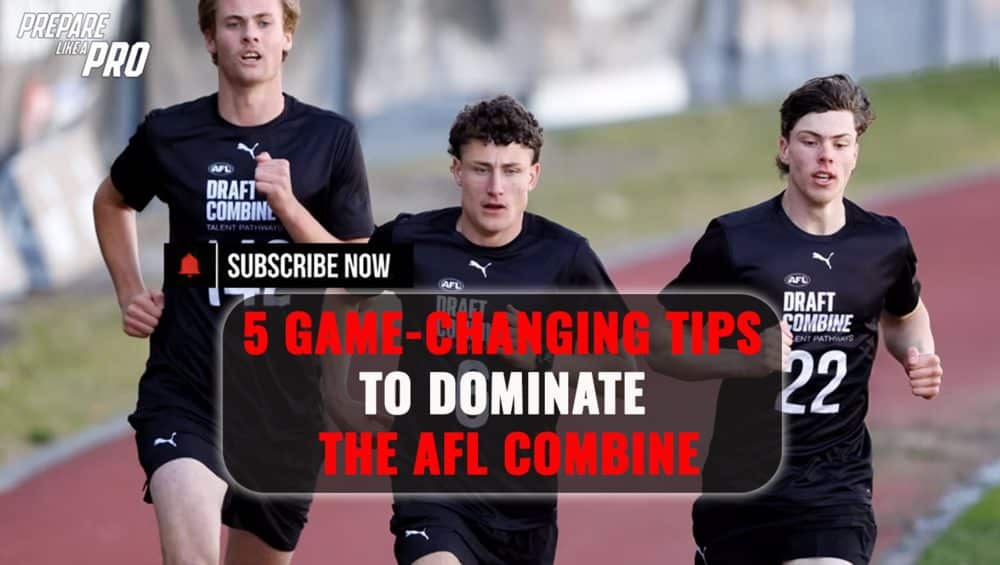
#bitesize – 5 Game-Changing Tips to Dominate the AFL Combine

Most athletes walk into the AFL Combine without a real plan, and AFL Combine Performance Preparation is often the missing piece. Focusing on proper AFL Combine Performance Preparation could be the difference between a good score and a great one, from why extra muscle might actually hurt you to the pacing mistake that catches everyone out.

AFL Combine Performance Preparation

Prioritise Weekly Match Performance

First, remember that your weekly match performance is still the most important measure of development. While combine testing can help showcase athletic ability, recruiters ultimately want players who perform consistently on game day. Therefore, avoid changing your entire training approach just to chase faster sprint times or higher jumps.

Instead, keep your in-season routine focused on recovery, skill work, and game preparation. For example, if an athlete adds too many extra sprint sessions, they may enter matches fatigued and underperform. As a result, the smartest approach is balancing combine preparation with strong weekly performances.

Maintain an Optimal Playing Weight

Next, focus on staying at a playing weight that supports speed, agility, and endurance. Combine tests often reward athletes with a strong power-to-weight ratio. In other words, being lean, powerful, and athletic usually leads to better results than simply adding more muscle mass.

For instance, if a player increases body weight too quickly, their sprint speed or jump performance may decline. Therefore, aim to build useful strength while maintaining a body weight that allows you to move efficiently across the ground.

Build Strength and Aerobic Capacity

At the same time, developing strength and an aerobic base should remain key priorities. The more force an athlete can produce, the more effective they become when sprinting, jumping, or changing direction. Strength training improves this force production.

Meanwhile, low intensity aerobic work supports recovery and builds endurance. As a result, athletes are better prepared for tests such as the 2 km time trial while also handling the physical demands of weekly training and matches.

Train Sprint Mechanics with Purpose

Another important step is improving sprint mechanics each week. Speed development is not only about running faster but also about running more efficiently. Focus on explosive first steps, strong forward body angles, and controlled posture at top speed.

For example, short acceleration drills, resisted sprints, and technical sprint work can gradually improve force application into the ground. Consequently, these small improvements can lead to meaningful gains in sprint performance.

Prepare Smart for Combine Day

Finally, preparation for combine testing should be practical and structured. Practice each test beforehand so you understand pacing, especially for endurance events. This helps remove uncertainty when the testing day arrives.

Additionally, organise your equipment ahead of time. Bring spare socks, extra shoes, food, and fluids so small issues do not affect performance. When athletes arrive calm, prepared, and confident, they are far more likely to perform at their best.

Highlights from the episode:

– Tip #1: The weight room trap that kills your combine scores
– Tip #2: Why your aerobic training might be sabotaging you
– Tip #3: The acceleration secret most players overlook
– Tip #4: The pacing strategy that separates top performers
– Tip #5: The mindset shift for combine day

🎥 Watch full episode on YouTube
🔗 https://www.youtube.com/@preparelikeapro
📅 Book a FREE discovery call for coaches
👉 https://calendly.com/plp2

Listen Now & Subscribe!

🎧 Available on Spotify, Apple Podcasts, and YouTube
📲 Follow us on Instagram: @preparelikeapro
💡 Learn more at preparelikeapro.com

Listen: iTunes | Spotify

Are you ready to enhance your coaching? Uncover the strategies to build a thriving online platform, liberating yourself from the time-for-money constraints while pursuing a career as an AFL S&C coach.

Book a FREE coaches discovery call at
https://calendly.com/plp2/15min

🚀 Ready to level up your gaming skills in record time? Join our exclusive Game Speed Coaching Program today! With personalized coaching, you’ll unlock your full potential and dominate the competition.

🕒 But hurry we’re only accepting 10 participants for this round! Secure your spot now before it’s all gone!

Click here to join and reserve your spot: https://bit.ly/game-speed-coaching-program

Don’t miss this opportunity to take your speed to the next level. Act fast and start your journey towards becoming the fastest player on game day!

AFL Explosiveness Standards GuideCategoriesFooty Tips Podcast

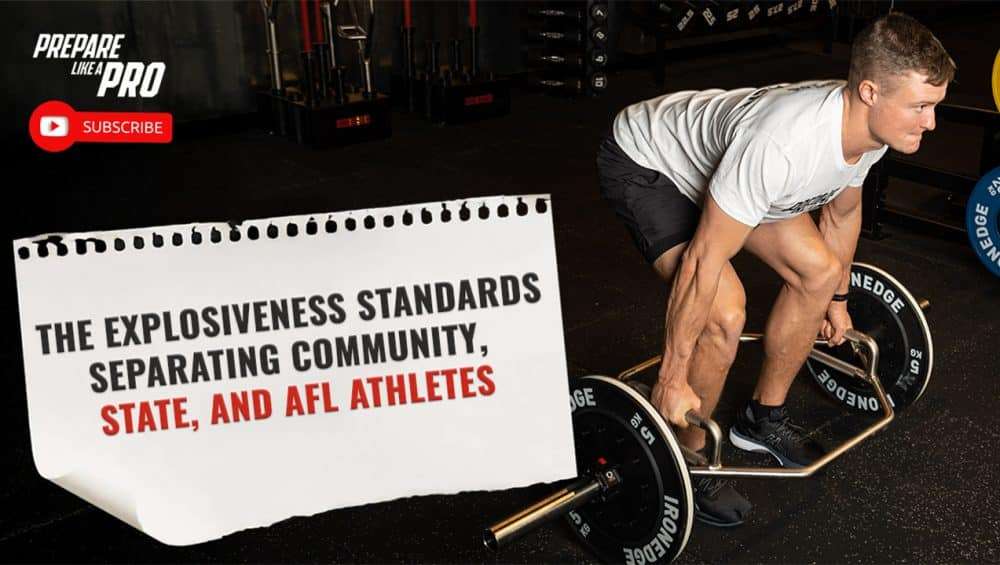
#bitesize – The Explosiveness Standards Separating Community, State, and AFL Athletes

How strong and explosive do you really need to be to compete at AFL, state, or community level? AFL Explosiveness Standards Guide In this episode, we break down clear lower-body strength benchmarks using squat and trap bar deadlift standards, then unpack power-to-weight targets from countermovement jump testing so you can see exactly where you sit. You’ll learn how to improve force production, reduce ground contact time, and build real on-field explosiveness through practical drills like skipping, single-leg hops, depth jumps, loaded jumps, and Olympic lift variations, with simple progressions coaches and sport scientists can apply immediately. AFL Explosiveness Standards Guide

AFL Explosiveness Standards Guide

Benchmarks that matter

If you want a quick self-check, the AFL explosiveness standards guide starts with strength. For athletes training consistently, an AFL-level minimum is about 2x bodyweight on a key lower-body lift such as a squat variation or trap bar deadlift. State level usually sits around 1.5–1.9x, while under 1.5x often reflects community or developing athletes. If you’re under 18, keep perspective: learn great patterns and build habits.

Power targets from the CMJ

Next, look at power on a countermovement jump (slow stretch-shortening cycle). A practical benchmark is power-to-body-mass around 8 per kg for AFL level, 7.0–7.9 for state, and under 7 for community. Testing systems differ, so focus on the trend and your progression.

Diagnose what’s holding you back

Then ask: are you sticky on the ground or simply not projecting? If jump height is decent but contact time is long, you likely need better reactivity. Conversely, if contact time is quick but you’re not moving up or out, you need more force in the right direction.

Train the limiter with simple drills

Therefore, for long contacts, cue hot coals and prescribe skipping and single-leg skipping for about 100 total contacts (50 each side). For poor projection, use depth jumps where you drop off a box and land onto a box, aiming for high hips in an athletic position. Progress the landing box gradually (30 cm to 35 cm to 40 cm) once quality holds.

Build power without guesswork

Finally, if your CMJ power is below standard, layer in loaded squat jumps, Olympic lifting, or simpler options like hang pulls and med ball throws. Add generous rest so every rep is fast and crisp, and you’ll steadily move up the standards ladder. Start with 2–3 sets and stop before speed drops each session.

Highlights from the episode:

– Build a technical model for acceleration and max velocity
– Why kinograms still work and what movement bias tells us
– SMAS markers that reveal efficiency and hamstring risk
– How SMAS scoring turns mechanics into coachable priorities
– Bucketing a squad using sprint mechanics plus force and strength tests

🎥 Watch full episode on YouTube
🔗 https://www.youtube.com/@preparelikeapro
📅 Book a FREE discovery call for coaches
👉 https://calendly.com/plp2

Listen Now & Subscribe!

🎧 Available on Spotify, Apple Podcasts, and YouTube
📲 Follow us on Instagram: @preparelikeapro
💡 Learn more at preparelikeapro.com

Listen: iTunes | Spotify

Are you ready to enhance your coaching? Uncover the strategies to build a thriving online platform, liberating yourself from the time-for-money constraints while pursuing a career as an AFL S&C coach.

Book a FREE coaches discovery call at
https://calendly.com/plp2/15min

🚀 Ready to level up your gaming skills in record time? Join our exclusive Game Speed Coaching Program today! With personalized coaching, you’ll unlock your full potential and dominate the competition.

🕒 But hurry we’re only accepting 10 participants for this round! Secure your spot now before it’s all gone!

Click here to join and reserve your spot: https://bit.ly/game-speed-coaching-program

Don’t miss this opportunity to take your speed to the next level. Act fast and start your journey towards becoming the fastest player on game day!

Train Smarter Not HarderCategoriesFooty Tips Podcast

#161 – Train Smarter, Not Harder: Jack McLean on AFL Strength Training Myths

In this episode, we break down what actually drives performance outcomes in team-sport athletes. Train smarter not harder from profiling and testing, to translating data into training decisions that coaches can execute. You’ll hear the key framework we use to connect sport science metrics to on-field speed, repeat-effort ability, resilience, and return-to-performance, plus the most common mistakes practitioners make when chasing “good numbers” that don’t transfer. If you’re a sport scientist, S&C coach, physio, or performance lead, this one will help you simplify your monitoring, sharpen your programming, and make your data more useful on the grass.

Train Smarter Not Harder

Train smarter through seasons

Paragraph: Training smarter starts with planning the year, not just the next session. In October, think reset and recovery. Then, in November and December, you can progressively build key athletic qualities and “squeeze the lemon” with intent. After a short Christmas break, January becomes your final maximise block. However, as you enter February, the focus should shift to optimise. That means you keep intensity high, yet you reduce total weekly gym volume by roughly 20–40% so athletes feel primed, not flat.

Spot the signs early

Paragraph: If you don’t strip volume at the right time, performance usually whispers before it screams. For example, you might notice heavy legs, constant soreness, disrupted sleep, or poor focus in meetings. Therefore, these signals are useful feedback. They often mean the athlete needs less total work and more quality. In other words, training smarter is knowing when to chase gains and when to protect freshness.

Build speed that transfers

Paragraph: Speed still comes back to basics done well. Firstly, accelerations matter, especially the first three steps. Secondly, sprint exposure matters, whether it’s straight or slightly curvy. A simple, safe option is the flying 60. Build for 20m, hold around 90% for 20m with tall, relaxed posture, then decelerate for 20m and walk back. As a result, you develop top-end speed without unnecessary risk.

Develop agility and power with intent

Paragraph: Agility is best trained in football contexts where decisions matter. So, use 1v1, 2v1, 3v3 and small-sided games to force reacting under pressure while executing skills. Meanwhile, power can be built with Olympic lift variations like hang power cleans and push jerks for efficient movers, plus medicine ball throws and a blend of loaded and plyometric jumps. Importantly, include vertical, horizontal, and lateral vectors to match real game demands.

Strength for acceleration and contact

Paragraph: Finally, acceleration strength supports change of direction and collision tolerance. Heavy sled or prowler work is gold because it teaches horizontal force and clean shapes, like matching shin and trunk angles. You can also add change-of-direction patterns on the sled, such as backward 45s and lateral steps. Most importantly, sell the intent of each drill so athletes execute the plan, not just complete it.

Highlights of the episode:

– Why most sports science doesn’t transfer to performance
– What actually drives game speed
– Why agility is about decision making, not drills
– How power training really carries over to football
– Understanding force vectors and movement direction
– Managing soreness, intent, and athlete buy-in

🎥 Watch full episode on YouTube
🔗 https://www.youtube.com/@preparelikeapro
📅 Book a FREE discovery calls for coaches
👉 https://calendly.com/plp2

Listen Now & Subscribe!

🎧 Available on Spotify, Apple Podcasts, and YouTube
📲 Follow us on Instagram: @preparelikeapro
💡 Learn more at preparelikeapro.com

Listen: iTunes | Spotify

Are you ready to enhance your game? Our program is designed to propel footballers, like yourself, towards more excellent fitness, speed, and strength, ensuring you’re fully prepared to dominate on the field!

Book a FREE footballer discovery call

at https://calendly.com/plp2/15min

🚀 Ready to level up your gaming skills in record time? Join our exclusive Game Speed Coaching Program today! With personalized coaching, you’ll unlock your full potential and dominate the competition.

🕒 But hurry we’re only accepting 10 participants for this round! Secure your spot now before it’s all gone!

Click here to join and reserve your spot: https://bit.ly/game-speed-coaching-program

Don’t miss this opportunity to take your speed to the next level. Act fast and start your journey towards becoming the fastest player on game day!

In Season Athlete DevelopmentCategoriesFooty Tips Podcast

#bitesize – Optimizing vs Maximizing Athlete Development in Season

This episode breaks down the difference between optimizing and maximizing in-season athlete development. We discuss when to prioritize game-day performance versus long-term growth, common high-performance mindsets in AFL clubs, how to spot overreaching versus adaptation, simple ways to monitor training without expensive tech, and practical recovery strategies for different athletes. Essential listening for coaches and sport scientists managing performance and fatigue.

In Season Athlete Development

Optimize vs Maximize in Season

In season, high performance coaching often comes down to two lanes. First, you can optimize so the athlete feels fresh, confident, and ready to perform on the weekend. Alternatively, you can maximize by pushing physical development harder during the week, so the athlete builds qualities that pay off later. Both approaches work; however, the right choice depends on the athlete, the squad profile, and the competitive timeline.

When To Choose Optimization

Optimization suits athletes who already have a strong training age, are managing high game loads, or are in a phase where availability matters most. Therefore, the focus becomes quality over quantity, maintaining strength, power, and speed with the minimum effective dose. For example, keeping gym exposures tight and consistent can protect performance, reduce soreness, and improve readiness. As a result, the athlete can attack the weekend with better energy and clarity.

When To Choose Maximization

Maximization fits younger athletes or developing squads who still need meaningful growth in speed, strength, size, or explosiveness. However, this lane carries a cost. More volume and intensity can increase fatigue and elevate injury risk if it is not managed well. Consequently, maximizing demands tighter planning, smarter progressions, and stronger communication with coaches and medical staff.

How To Monitor If It’s Working

Even without fancy data, subjective monitoring is powerful. Ask athletes weekly about energy, motivation, mood, and how their body is handling the load. Additionally, check in with coaches about football form and training intent. If energy drops and performance dips, then you may be overreaching. On the other hand, if athletes are lively, confident, and hitting PBs, you are likely on the right track.

Standardize Testing and Stay Honest

To make good decisions, your testing must be repeatable. Use the same exercise setup, same range of motion, and the same equipment each time. Moreover, track movement quality and bar speed, not just weight. If an athlete moves the same load faster with clean shape, that is a strong sign the program is delivering.

Highlights from the episode:

– Optimizing versus maximizing athlete development in season
– The maintenance mindset versus accelerated growth programs
– How to spot overreaching versus thriving athletes
– Practical ways to test and monitor program effectiveness
– Recovery differences between optimize and maximize groups

🎥 Watch full episode on YouTube
🔗 https://www.youtube.com/@preparelikeapro
📅 Book a FREE discovery call for coaches
👉 https://calendly.com/plp2

Listen Now & Subscribe!

🎧 Available on Spotify, Apple Podcasts, and YouTube
📲 Follow us on Instagram: @preparelikeapro
💡 Learn more at preparelikeapro.com

Listen: iTunes | Spotify

Are you ready to enhance your game? Our program is designed to propel footballers, like yourself, towards more excellent fitness, speed, and strength, ensuring you’re fully prepared to dominate on the field!

Book a FREE footballer discovery call

at https://calendly.com/plp2/15min

🚀 Ready to level up your gaming skills in record time? Join our exclusive Game Speed Coaching Program today! With personalized coaching, you’ll unlock your full potential and dominate the competition.

🕒 But hurry we’re only accepting 10 participants for this round! Secure your spot now before it’s all gone!

Click here to join and reserve your spot: https://bit.ly/game-speed-coaching-program

Don’t miss this opportunity to take your speed to the next level. Act fast and start your journey towards becoming the fastest player on game day!