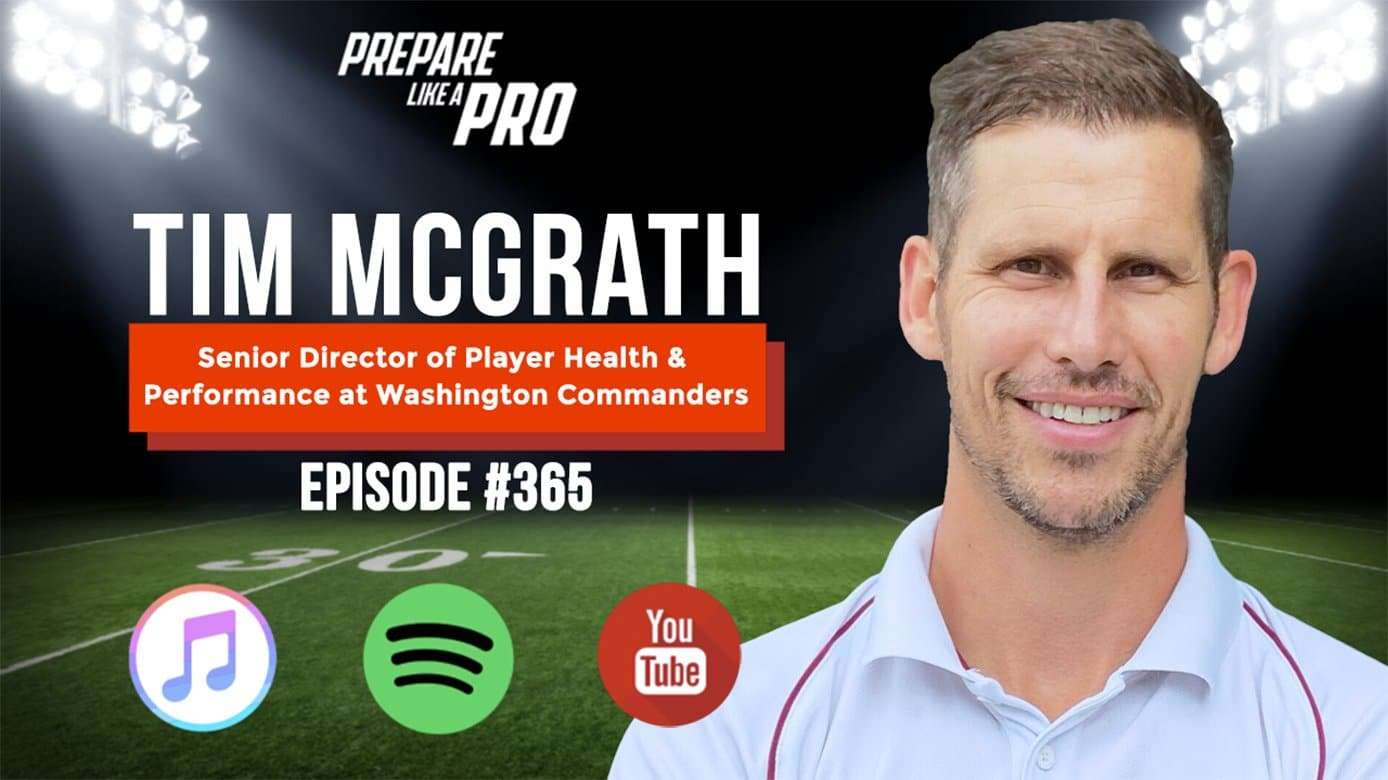
What does it actually take for an Australian sports scientist to earn a seat inside an NFL franchise? NFL Player Health Strategy sits at the heart of this conversation, and Tim’s journey inside the Washington Commanders shows just how complex that challenge can be. With no playbook for the job, he had to navigate new ownership, cultural mismatches, and a locker room built on institutional mistrust, all while building an NFL Player Health Strategy from the ground up. In this episode, he breaks down how he rebuilt player welfare, what the NFLPA survey results revealed, and why his most important screening tool is not a wearable or a jump mat. It is a conversation.
NFL Player Health Strategy
Trusted Relationships Open Doors
Tim McGrath’s move into the NFL did not happen by chance. Instead, it grew through trusted relationships and a strong professional reputation. When new ownership arrived at the Washington Commanders, they wanted to strengthen their high-performance model and improve how player health was supported across the club. Therefore, Tim was brought into conversations around vision, structure, and long-term strategy. His journey involved multiple trips to the United States, several leadership meetings, and plenty of planning before the role truly took shape.
Fix The System, Not Just the People
One of the clearest lessons from Tim’s approach is that performance problems are not always about staff quality. In this case, he believed the bigger issue was limited resourcing, unclear systems, and structures that were not helping people do their best work. So, rather than simply bringing in familiar colleagues, he focused on building a better environment. That mindset matters in every high-performance setting because strong people still need strong systems around them to succeed.
Bigger Departments Need Better Alignment
The NFL environment also brought a different level of scale. Budgets were larger, departments were bigger, and the number of athletes and staff created a much more complex communication challenge. However, more resources do not automatically create better outcomes. They only help when everyone is aligned and the spending is purposeful. Tim highlighted that in large organizations, keeping departments connected and moving in the same direction is one of the biggest drivers of success.
Conversation Still Matters Most
When it came to monitoring athletes, Tim leaned heavily on trust and honest conversation. Although formal tools and surveys can be useful, he found that direct communication often revealed more. In some environments, players may not fully trust structured monitoring, which makes informal check ins even more valuable. Ultimately, good player health strategy is not just about data collection. It is about building relationships, creating clarity, and knowing when a conversation tells you more than a test ever could.
🔑Highlights from the episode:
– How an Australian sports scientist landed a role inside an NFL franchise through word of mouth
– What a player welfare survey ranking of 32nd out of 32 told Tim about where to start
– The language barrier nobody warned him about when moving from Australia to the NFL
– Why bigger budgets and bigger departments create their own set of problems
– Why Tim trusts conversation over jump monitoring for reading player readiness
🎥 Watch full episode on YouTube
🔗 https://www.youtube.com/@preparelikeapro
📅 Book a FREE discovery call for coaches
👉 https://calendly.com/plp2
Are you ready to enhance your coaching? Uncover the strategies to build a thriving online platform, liberating yourself from the time-for-money constraints while pursuing a career as an AFL S&C coach.
Book a FREE coaches discovery call
https://calendly.com/plp2/15min